Home Blog

Why Investors Are Misreading the AI vs Software Story

I’m noticing a growing disconnect in the markets today. My investor friends are acting schizophrenic—pouring capital into companies growing 40% to 50% a year, like Figma, while turning their backs on firms growing 10% to 15% annually, like Adobe or Workday. I guess steady growth, billions in free cash flow, and entrenched customer bases aren’t exciting enough anymore.

Take Workday. Granted, its stock has been flat for five years, yet it’s generating over $2.5 billion in free cash flow and still expanding revenue at a double-digit clip. My friends seem to be tossing out solid businesses like old cargo, assuming companies like Workday or Salesforce will be swept aside by the AI wave.

That’s a mistake.

These companies—Workday, Salesforce, Adobe—own the customer. The idea that global enterprises like Procter & Gamble, Nike, or Pepsi are going to rip out their ERP systems that took decades to deploy and replace them with some shiny new AI startup is pure fantasy.

Enterprise software is sticky. Integration is costly. Trust takes years to build.

And it’s not as if these incumbents are sitting still. They are building their own AI assistants and tools. These companies will continue to innovate and reinvest in AI and will likely benefit from this transition, not be destroyed by it.

The Moat Isn’t Code—It’s Distribution

Where my investor friends really get it wrong is in a fundemental misunderstanding of what makes software companies valuable. They think software is like semiconductors—built on deep, defensible tech. It isn’t. For software companies, the real moat isn’t the code; it’s the customer relationships, distribution channels, and trust.

I invest in a small business in Minnesota that builds Chamber of Commerce software. It’s a $40 million company, profitable, growing nicely. Could Microsoft crush us if they wanted? Sure. They could assign 100 engineers to the problem and out-code us in a week. But they don’t. Why? Because software is fragmented across tens of thousands of micro-verticals. No one can attack everything at once. Success in software has always been more about distribution than R&D.

The Forgotten Strength of Incumbents

In public markets, fortunes are made by buying great franchises when they’re out of favor. Companies like Salesforce and Workday have loyal customers and high retention. As long as they keep innovating, they’re well-positioned to thrive in the next cycle.

Remember when e-commerce took off in the 1990s? The winners weren’t all new startups. Many of today’s top online retailers—Home Depot, Target, Walmart—were around back then. Sears and Kmart didn’t lose because they were old; they lost because they stopped adapting. Walmart became a tech company in disguise, hiring software engineers and building infrastructure.

Innovation, not age, determined survival.

The same will be true for software. Those who evolve with AI will endure and even expand their lead.

The Early Innings of AI ROI

Right now, AI’s impact is still on the fringes. Enterprises are experimenting, not overhauling. CFOs are asking the right questions: how much will this cost, and when will it deliver real ROI? It’s the beginning, not the end, of the adoption curve.

So yes, AI is transformative—but not in the way some of my investor friends think. The winners won’t just be flashy startups. Many incumbents will absorb AI into their products, leveraging their scale, distribution, and customer trust.

In other words: don’t write off the old guards just yet. History shows that innovation rewards those who already have the customers—and the discipline to keep earning them.


Part III — When Solidarity Turns Against the People

0

Every community has a story it tells about itself. It speaks of order, of safety, of shared sacrifice and shared benefit. But beneath that story is another truth, quieter and far more dangerous, the truth of what happens when someone in authority allows their loyalties to drift from the present toward the shadows of their past.

There is a kind of solidarity that begins in memory but ends in betrayal.
It is born from identification, from the soft ache of seeing a younger self in the trespassers who swarm the court. It starts as empathy, as understanding, as the familiar pull of old habits and old neighborhoods. But when left unchecked, it becomes something else entirely. It becomes a loyalty to disruption, a sympathy for the ones who violate the space, and a hardening against those who honor it.

This is solidarity turned inward, then twisted outward against the people who keep the community alive.

The trespassers shout late into the night, curse across the pavement, let smoke rise in the air that drifts into homes where children sleep. And yet the authority who should see this as a breach sees instead a mirror. The noise becomes memory. The disorder becomes nostalgia. The violation becomes a story he once lived and therefore feels compelled to protect.

But a community cannot survive the weight of someone else’s romanticized past.
And the people who pay the dues and trust the boundaries are left standing alone.

The faithful in authority understand this. They know that solidarity is not a matter of shared origin or shared struggle. It is a matter of shared responsibility. They know that real solidarity stands with the community, not with the people who test its limits. They know that nostalgia is not a principle. It is a temptation.

When authority chooses nostalgia over responsibility, the community pays the price. The loudest and most reckless become the ones protected. The most responsible become invisible. The covenant is broken from within.

This is how a neighborhood begins to fracture.
Not because outsiders pushed through the gate, but because someone on the inside held the gate open for the sake of a memory.

Solidarity captured by nostalgia is a dangerous thing.
It is the shepherd who sees himself in the wolf.
It is the guard who mistakes intrusion for innocence.
It is the leader who sees a trespasser and says, with a strange kind of pride, I remember being him.

But a community is not a stage for resurrecting old versions of oneself.
It is a living thing, fragile and dependent on the vigilance of those entrusted to protect it.

The faithful can hold the line for only so long.
They can endure only so much reinterpretation of harm, only so much indulgence of disorder. At some point, the authority shaped by nostalgia must confront what it has become, what it has enabled, and what it has allowed to erode.

Because the truth is this:
A community is not undone by its trespassers.
It is undone by the people who defend them.

Solidarity, when turned in the wrong direction, becomes betrayal.
And if a neighborhood is to survive, the authority within it must remember that loyalty to the past is no substitute for responsibility to the present.

Part II — The Weight Bent by Nostalgia

0

A community is not held up by good intentions. It is held up by discipline, by the unromantic work of boundaries and the people who honor them. Every neighborhood has those steady souls who understand this, the ones who treat responsibility as a living thing, not a slogan. They enforce what must be enforced, not because they enjoy confrontation, but because they know what disorder becomes once it takes root.

These are the faithful in authority.
And they stand in quiet contrast to another kind of authority entirely.

Because there are those who look at trespassers and see not a breach, but a reflection, some soft remembrance of who they were long ago. The loud voices on the court remind them of their own youth. The rough talk, the swagger, the disregard for space that is not theirs, it all stirs something familiar. Nostalgia becomes a lens, and through that lens the trespassers appear less like intruders and more like a younger version of themselves.

This is where the trouble begins.

Instead of guarding the community, this kind of authority guards its own memory.
Instead of drawing a line, it redraws the story.
Instead of naming harm, it names relatability.

The noise becomes a rite of passage.
The profanity becomes boys being boys.
The weed smoke drifting across fences becomes a phase.
The intrusion becomes something I used to do.

But nostalgia is a poor substitute for stewardship.
And when nostalgia governs authority, authority becomes unmoored.

The faithful, those who take the role seriously, are left carrying the burden. They uphold boundaries while others blur them. They enforce rules while others reinterpret them. They see trespassing as a threat to order, while others see it as a flashback. They understand that a community cannot survive on memory alone; it survives on responsibility.

But nostalgia has its own gravity.
It pulls weak authority backward into a boyhood long gone until the present loses its shape and its urgency. The courtyard is no longer a problem to solve but a story to relive. The trespassers become protagonists in a narrative the authority figure cannot bear to let go of.

And when authority identifies with disorder, disorder wins.

Not loudly.
Not violently.
But slowly, in the way a fence leans before it breaks.

The faithful watch this happen with a kind of quiet sorrow. They know what nostalgia disguised as empathy can do. They know how quickly a community unravels when the people charged with safeguarding it instead nurture the very behavior that undermines it.

Authority is not memory work.
It is boundary work.

And when those in power choose their past selves over the present needs of the community, the neighborhood bends, not under the weight of trespassers, but under the nostalgia of the very people meant to protect it.

The faithful remain.
They hold the line as best they can.
But they know this truth in their bones:

A community survives only when authority faces forward, not backward.

Part I — The Gate That Forgot It Was a Gate

0

This is only the first part of a larger meditation. In part two, we will follow the burden placed on the responsible when rules bend for the irresponsible. And lastly, we will confront the truth of how solidarity, when captured by nostalgia or guilt, can betray the very people it claims to protect.

For now, we begin here, with a gate that forgot it was a gate, and the quiet resignation of the families who stopped believing anyone would hold it shut.


A neighborhood does not collapse in a single burst of violence. It dissolves slowly, almost shyly, the way a coastline surrenders to the tide grain by grain. And sometimes the unraveling begins in a courtyard where a ball hits the pavement long after the streetlights have blinked awake, a rhythm played by hands that do not belong to the people who paid for the court.

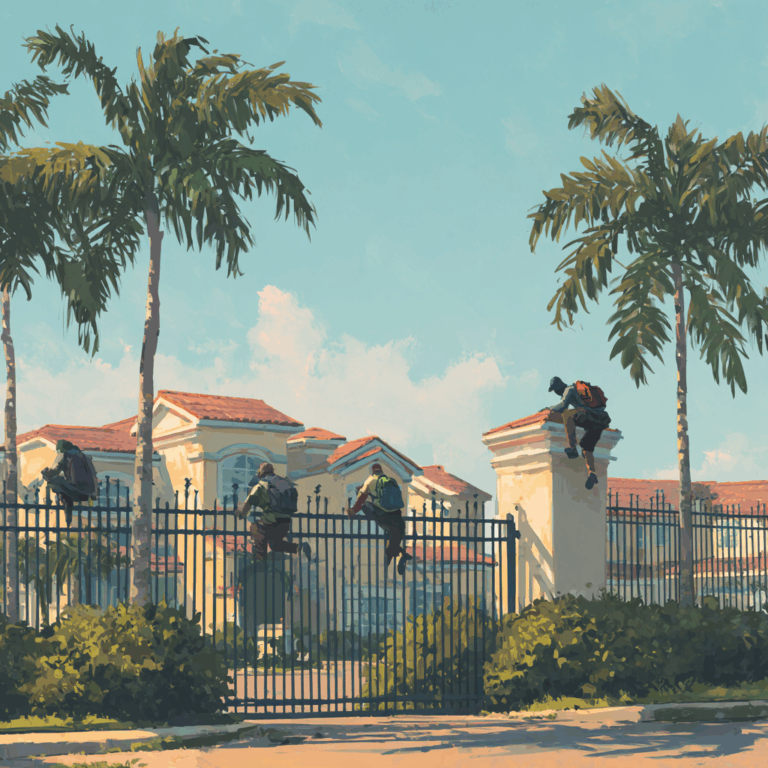
The basketball court sits behind a locked gate, pressed between homes where parents fold laundry, help with homework, and whisper prayers that the world will be gentle with their children. It was built as a promise—a sanctuary sealed by boundaries, quiet by design. But the nights have shifted. Outsiders slip in. Boys and young men from elsewhere arrive in clusters. Their voices swell beyond play into something sharper, louder. Cursing cuts through the air. Weed smoke rises and drifts across fences, slipping into open windows where children try to sleep.

And inside those houses, the families who fund this place brace themselves for another night they did not ask for.

They have complained. Many times. At first with urgency, then with hope, then with something closer to pleading. And their words were met with a familiar pattern—half-measures, brief gestures, promises that wilted under the next wave of trespassers. A sign here. A reminder there. A momentary show of concern that changed nothing at all.

So the families did what people do when they realize help is not coming—they grew quiet. They closed their windows. They kept their grievances to themselves. They stopped believing that anyone in authority would protect what they purchased. Resignation became its own kind of neighborhood language.

And hovering over all of it is a strange tenderness in the way authority explains the chaos. Not a defense of the boys in the courtyard, but a nostalgia that softens the edges. Someone—someone with the power to guard the gate—remembers being like them. Remembers the noise. The recklessness. The pull of a game on a court that wasn’t theirs. And in the warm light of that memory, present violations become sentimental echoes of a past self.

The profanity becomes “kids being kids.” The weed becomes “a phase.” The trespassing becomes “something I used to do.”

In the name of empathy, the truth grows distorted. And the neighborhood pays the price.

But empathy without responsibility is not kindness. It is a quiet form of abandonment. A community cannot survive on understanding alone.
It needs boundaries—firm ones, respected ones, ones that mean something even when nostalgia whispers otherwise.

A gate that does not guard is not a gate. It is stage scenery.

And the courtyard behind it becomes the symbol of a deeper unraveling: a community losing itself not to outsiders, but to the soft failures of those charged with its defense.

Influencers, NGOs, and Gangs: The Shallow Rungs of Haiti’s Ladder

0

Haiti is drowning in noise. The chatter of morning radio. The endless quarrels on WhatsApp. The processions of aid trucks plastered with foreign logos. The livestreams, the hashtags, the slogans. Noise so thick it masquerades as movement.

But noise is not structure. And structure is what endures.

Nassim Nicholas Taleb gives us a ladder: People → Events → Ideas → Systems → Architectures. A hierarchy of consequence. The higher you climb, the more you shape reality itself. The lower you remain, the more you narrate a world that someone else has already built.

People

At the base are the faces—politicians, pastors, influencers, anyone who lives on recognition. They rise and fall with attention. They narrate the moment but cannot outlive it.

Influencers like Carel Pèdre or Berthrude Albert play here. They mobilize attention, they frame stories, they shine light. But they remain bound to the fragile whims of algorithms and donors. Their reach is real, but it is not structural.

Events

Next are the happenings—the march, the protest, the fundraiser, the viral hashtag. They stir the body, but they fade like storms. Carel’s livestream may galvanize thousands, Berthrude’s campaign may raise quick money. NGOs excel at this level, staging spectacles for donor reports. But when the cameras leave, the scaffolding collapses.

And here, too, are Haiti’s gangs. They stage blockades, kidnappings, and massacres that seize the nation’s breath. These are events—explosive, terrifying, disruptive. They force attention, but they leave little residue beyond trauma. When one gang falls, another takes its place. Events of violence, not systems of justice.

Ideas

Ideas endure longer. Liberty. Sovereignty. Human dignity. Haiti gifted these to the world in 1804. But ideas need soil—debate, teaching, institutions—to grow. Without that, they rot into slogans, recycled by NGOs, parroted by politicians.

Gangs do not trade in ideas. Their currency is fear, not philosophy. They occupy headlines but not history.

Systems

Systems are where change becomes real. A school that functions without favoritism. A court that judges without bribes. A clinic that heals without “knowing someone.” Systems are the bones of a nation.

NGOs pretend to build systems, but too often they erect shadows—parallel networks, tethered to donor dollars. They mimic permanence but vanish when the money dries up.

Gangs, too, claim systemhood in the neighborhoods they dominate: they collect “taxes,” they enforce “laws,” they decide who lives or dies. But this is not a system—it is an anti-system, parasitic, sustained only by the absence of state systems. It thrives on vacuum. It is fragile the moment sovereignty returns.

Architectures

At the top are the invisible frameworks that define the possible. Constitutions. Energy grids. Financial networks. These are architectures—so deep they feel like nature itself.

Here is where Haiti has been abandoned. Our financial architecture is wired to dependency. Our political architecture fractured by design. No influencer touches this. No NGO sustains this. No gang reaches this. Architectures belong to the builders, not the narrators, not the destroyers.

The Fragility of Narrators and Predators

Influencers narrate. NGOs perform. Gangs terrorize. They all operate in the shallow rungs of people and events. They dominate attention but not history. They shape fear, not futures.

The deeper levers—systems and architectures—remain untouched, and until Haiti climbs, noise will rule us.

A Haitian Case: Remittances

Look at remittances. At the event level, we celebrate when money floods in after a quake. At the system level, we might regulate transfer costs, create diaspora bonds. At the architecture level, we could rewire the economy so remittances build sovereignty, not dependency.

That is the climb we refuse to make.

The Climb We Must Make

Haiti is a land of personalities and gangs, of events and spectacles. But it is barren of systems, starved of architectures. This is why we regress. We waste energy at the bottom.

Progress means moving beyond faces, beyond fear, beyond photo ops. It means systems that endure, architectures that sustain.

Closing Word

Fraudulent NGOs thrive at the bottom. Influencers, no matter how sincere, remain there too. Gangs, with all their terror, live trapped in the same shallow strata.

But nations endure at the top. Systems and architectures are slow, invisible, unglamorous—and they are the only things that last.

So measure Haiti’s future not by the influencer’s trend, not by the NGO’s ribbon-cutting, not by the gang’s blockade. Measure it by whether systems are built. Measure it by whether architectures are sovereign.

Ask always: are we still narrating reality, or are we finally shaping it?

A Multi-Level Vision for Harnessing the Haitian Diaspora’s Remittances

0

“Men anpil, chay pa lou.” (Many hands make the load light.)

I have carried this proverb with me for as long as I can remember, and I hear it now as I think about the lifelines our people send home — those steady streams from Boston, Miami, Montreal, Paris, Santiago — and how they flow into the hands of mothers, brothers, cousins, neighbors.

They are the many hands already at work. And yet, as I reflect, I see how much lighter the load could be if we gave these streams a common direction, a deliberate course, so that they might carry more than survival — they might carry transformation.

My own study of the Philippine experience has left me in that curious state of being impressed and unsettled at once. I have admired their breadth of vision — a policy that works on the national, bilateral, and multilateral fronts — and yet I have been aware of the seams and fractures beneath it: the difficulty of enforcing protections, the temptation to celebrate deployment numbers while neglecting the conditions under which people live and work abroad.

I want us to learn from that model, but also to surpass it — to do, in short, what Haiti has never been afraid to do when necessity and imagination conspire.

Principles I Cannot Let Go

First, I must insist on equity. If we are to take these billions in remittances and make them the backbone of development, they cannot serve only those fortunate enough to have relatives abroad. They must spill over into infrastructure, education, and the patient building of local economies.

Second, I believe in protection. It is not enough for a Haitian to find work in Santiago or New York; it matters profoundly that the work is safe, that the wage is fair, that dignity travels with the passport.

Third, I think constantly about sustainability. We must invest these funds in structures and institutions that outlast the moment — that survive political seasons and personal fortunes.

And finally, I see that none of this can be done in isolation. Our approach must be layered — the national machinery, the bilateral agreements, the multilateral commitments — each speaking to and reinforcing the other.


On Our Own Ground

I would begin at home, with an institution that could both serve and defend our people: the Haitian Office for Diaspora and Migrant Affairs (HODMA). I imagine it as autonomous, yet answerable to the Prime Minister, and unlike certain foreign models, entirely free from the conflict of selling our labor while pretending to protect it.

Alongside it, a Haitian Diaspora Development Fund (HDDF), independent, audited, and jointly governed by diaspora voices, civil society, and the state.

I would finance it modestly — a voluntary solidarity contribution on formal transfers, matched by state or donor support, and the issuance of diaspora bonds. In this way, the remittance, without losing its private character, takes on a public one.


Turning Private Flows into Public Growth

I have been struck, in the Philippine case, by how much of the remitted dollar ends up as consumption. Necessary, yes — but insufficient. In Haiti, I would make it possible for every gourde saved in a certified remittance account to be matched for investment in small and medium enterprises, agricultural cooperatives, and the sort of community infrastructure that changes daily life.

I would insist on universal digital access to these services. To leave whole communes outside the financial map would be to admit, from the start, that the policy is for some Haitians and not for all.


Before They Leave

I think often of the moment just before departure — the farewell in the airport’s humid air, the weight of the suitcase, the uncertain future. It is here we can equip our people: a National Pre-Departure Orientation Program (NPDO) that teaches rights, financial literacy, and job-specific skills. This is not charity; it is strategy.


The Necessary Conversations Abroad

I have learned that agreements made face-to-face matter more than lofty declarations. I would seek binding Bilateral Labor Agreements (BLAs) with the countries where our people go in greatest numbers — the United States, Canada, France, the Dominican Republic, Chile — with enforceable clauses on wages, conditions, and automatic enrollment in portable social security.

I am not interested in the polite but toothless Memorandum of Understanding; I have seen how such documents soothe consciences without changing realities.

And I would go further: using these talks to lower the cost of sending money home, until the fee no longer feels like a tax on love.


Our Place in the World’s Forums

I am persuaded that we must take our voice to the broader tables — the International Labour Organization (ILO), the United Nations’ conventions on migrant workers, the Caribbean Community (CARICOM) — but only if we are prepared to enforce at home what we ratify abroad. Too often, membership has been the end of the effort. I would make it the beginning.


How I Would Keep Us Honest

I want an annual State of the Diaspora Remittance Impact Report, published in Creole and French, co-written with diaspora representatives, and read not only in Port-au-Prince but in Brooklyn, Montreal, and Santiago. I want an Ombudsman for Migrant Affairs, with the power to investigate, to shame, and to correct.


The Road I See Ahead

In the first two years, I would set up HODMA and the HDDF, launch the solidarity contribution, and negotiate two pilot labor agreements. In the next three, I would expand investment programs, deepen the CARICOM initiative, and ratify key ILO conventions. By year ten, I would want to see half of all formal remittances flowing through accounts that double as development engines, and universal access to digital transfers.


I do not imagine this as a perfect design — policy rarely is — but as a framework that recognizes what we have: a diaspora willing to give, a nation in need of more than subsistence, and a moment in which the gap between the two can be bridged.

If we treat our people abroad not merely as senders of money but as co-architects of Haiti’s future, then perhaps the remittance, born of absence, can become a presence in every Haitian life.

“Piti piti zwazo fè nich li.” (Little by little, the bird builds its nest.)
This, too, is what I believe: that steady effort, wisely guided, can make something enduring.

I Have Avenged America: Jean-Jacques Dessalines and Haiti’s Fight for Freedom

0

Haitian Connections: Recognition After Revolution in the Atlantic World.

Anti-Haitianism in the Bahamas

Haiti Since 1804: Critical Perspectives on Class, Power, and Gender

0

Subtotal